
Nano-engineering and spintronic technologies
Our researchers
The nano engineering and spintronic technologies (NEST) group focuses on understanding the physical processes and developing the fundamental understanding necessary to create the computational and data storage devices of the future.
The NEST home page has more information.
Our research includes exploring recent device ideas in non-conventional computing and encompasses a broad range of activities to explore the spin of electrons in nanoscale magnetic structures. The group interacts strongly with the Henry Royce Institute for advanced materials and the National Graphene Institute. We regularly use large scale facilities in the UK and Europe for neutron and X-ray scattering and have wide range of collaborators in the UK and Europe.
Research focus
Our activities and interests are best illustrated through the range of projects undertaken in the NEST group:
-

Magnetic random access memory – a developing paradigm in data storage
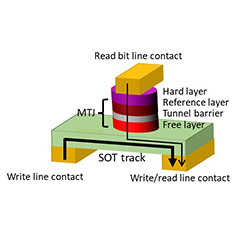
Magnetic Tunnel Junctions (MTJ’s) where an atomically thin insulating barrier – typically MgO – sandwiched between two ferromagnetic layers – CoFeB – acts as a switchable spin filter are at the core of spintronics. Our research involves creating and characterizing prototype MTJs for Spin Orbit Torque – MRAM (SOT-MRAM) and for a new class of Spin Torque Oscillator (STO) which can be used to enhance the data storage capacity of hard disk drives and for sensing. Excitingly, STOs have recently been demonstrated for neuromorphic computing circuits opening new possibilities for artificial intelligence (AI).
-
Spin wave phenomena – from understanding fundamental physics to neuromorphic computing
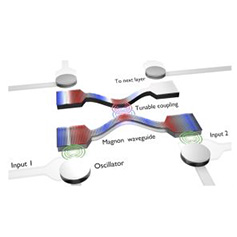
Spin dynamics – the coherent, high frequency (~GHz) precession of spins in magnetically ordered systems – is one of the fundamental phenomena used in spintronics to explore materials and create functional devices. Spin dynamics give rise to spin waves (sometimes called magnons) which can be exploited in devices. Our work seeks to develop an understanding of dynamic phenomenon in exchange coupled multicomponent magnetic thin films. This not only allows the key properties of these novel systems to be explored but provides a possible route to create dedicated computational elements such as classifiers and potentially more generally in neuromorphic computers.
-
Skyrmions – new approach to non-von Neumann computing
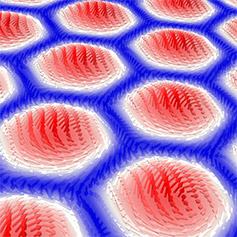
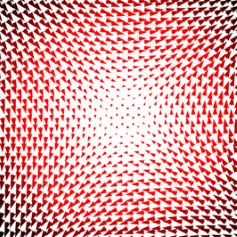
Magnetic skyrmions are nanoscale magnetic spin configurations with a whirling vortex-like spin structure that behave like quasi-particles and exhibit characteristic topological properties and intriguing dynamics. Their nanoscale size, robustness and ability to move with low electrical current densities, make them excellent candidates for integration in next generation magnetoelectronic devices. Our research includes a range of activities from fundamental topological switching process to using skyrmions for novel non-von Neumann nanocomputing. We take a holistic approach utilizing an array of techniques, from computational studies to developing skyrmionic multilayers and X-ray investigations.
-
THz spintronics – exploring new materials for the generation and detection of THz radiation
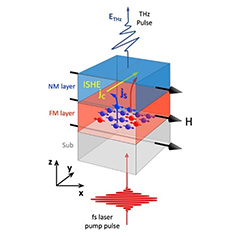
Spintronic terahertz emitters, consisting of ferromagnetic (FM)/non-magnetic (NM) thin films, have demonstrated real potential for use in terahertz time-domain spectroscopy and its exploitation in scientific research and industrial applications. A key feature of spintronic THz emitters is that they can generate pulses of THz radiation over a large spectral bandwidth. Our work involves the exploration of materials to further enhance THz emission through understanding of the spin-to-charge conversion process.
-
Spintronics with 2D materials – exploring TMDs for use in Spin-orbit torque materials
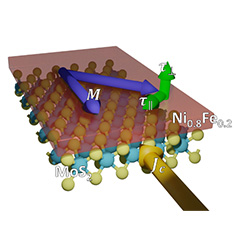
Transition Metal Dichalcogenides (TMDs) such as MoS2 are van der Waals layered materials with many potential uses in semiconductor, optical and spintronics technologies. They are usually semiconducting materials where it is possible to exploit their ability to generate spin orbit torques to manipulate a spin system. Our work, in conjunction with the vera Marun group, seeks to understand these spin orbit phenomena in TMDs/FM systems fabricated using CVD which, unlike conventional exfoliation methods, provides a clear route to large scale fabrication.
-
Functional magnetic materials
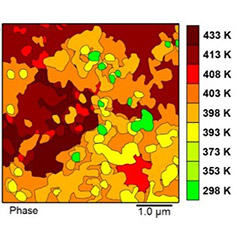
Underpinning the exploration of all new computational, data storage and sensing devices are advanced materials with designer properties. FeRh is fascinating material that changes from an antiferromagnet at room temperature to a ferromagnet at around 100°C. This allows the magnetisation to be “switched on” simply by heating. Combining this with other nanoscale magnetic materials provides the building block needed to create new classes of multifunctional spintronic devices.
-
Computational magnetism: from fundamental properties to technological applications
Our research focuses on developing theoretical frameworks and produce open source software able to simulate the dynamic and equilibrium properties of magnetic materials, such as thin films, multilayers, ferrimagnets, and antiferromagnets, which play a critical role in spintronics, data storage, and energy-efficient systems. By parametrising atomistic spin and spin-lattice dynamics models from first principles methods, we can access the magnetic behaviour at various timescales (from femtoseconds to 100s of nanoseconds). This enables us to investigate THz-induced spin dynamics, ultrafast switching, and relaxation processes in nanostructures, providing insights into non-equilibrium magnetization. Such computational approaches bridge fundamental physics with technological applications, supporting the design of advanced materials for ultrafast and energy-efficient magnetic devices.